

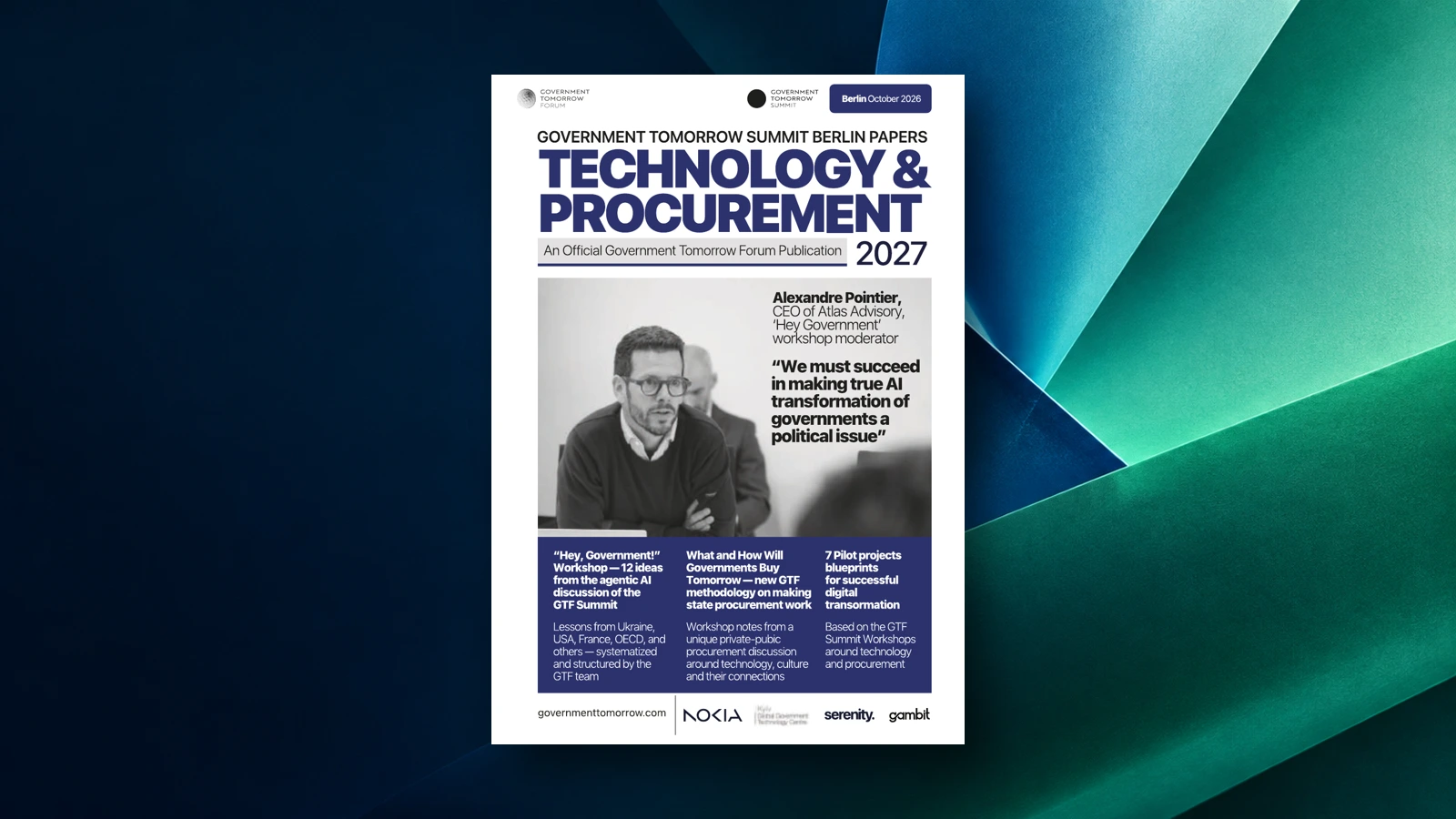
Technology & Procurement — Summit Paper
The State is not an app: agentic AI, intelligent public buying and seven pilot blueprints for meaningful digital transformation.
The State is not an app
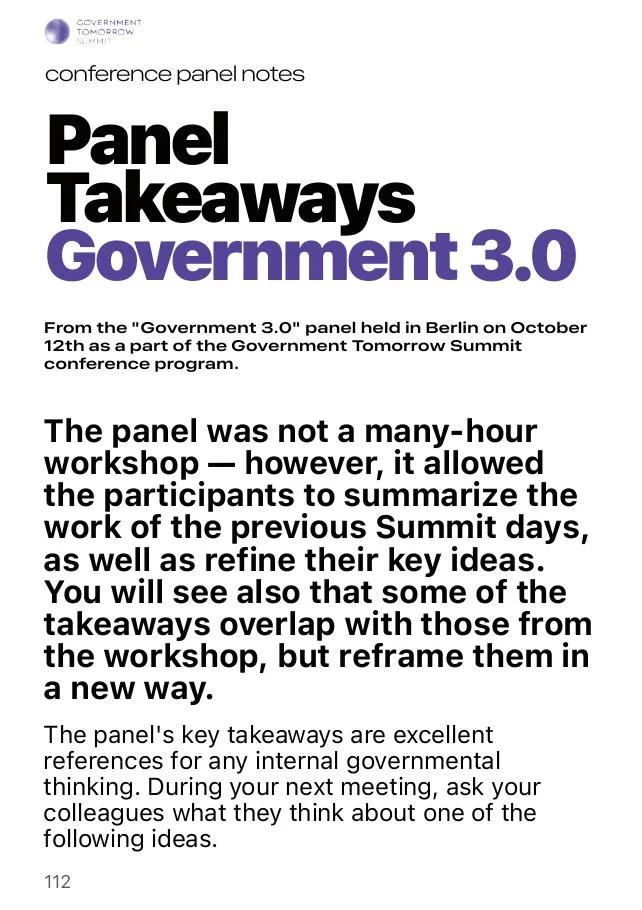
What should governments automate—and what must they retain? How can public procurement build capability rather than purchase another isolated product? This Government Tomorrow Summit Berlin paper brings together the “Hey, Government!” discussion, the “What Will Governments Buy Tomorrow” workshop and the Government 3.0 panel.
Key takeaways
1. Transformation first, digital second
AI cannot resolve objectives and institutional arrangements that nobody has reconsidered. Start from a public problem and the outcome people need, not from a tool looking for a use case.
2. Governments cannot outsource understanding
External suppliers can develop technology, but public institutions must retain the knowledge to define problems, challenge offers, govern architecture and remain accountable. Every transformation needs an institutional owner.
3. Keep purposeful friction
Remove unnecessary administrative burdens without removing safeguards that protect consent, appeal, deliberation and accountability. A frictionless interaction is not always a better public service.
4. Human approval is not the same as human agency
An official approving an AI recommendation is insufficient if officials and citizens cannot understand, question or overturn it. Government must remain the citizen’s agent, not merely a system acting upon them.
5. Buy public outcomes, not only products
Price is one dimension of value. Reliability, security, interoperability, maintenance, adaptability and supplier dependence shape the capability a purchase creates over its lifetime.
6. Procurement should be a learning process
Market dialogue can reveal that an initial requirement was wrong. Treat purchasing as a structured cycle of discovery and adjustment while preserving competition, legal responsibility and clear evaluation rules.
7. Architecture is a form of governance
Every purchase affects whether the State works as one system or disconnected institutions. Shared standards, portability and exit arrangements matter before contracts are signed.
8. Move beyond endless pilots without reckless deployment
Transparent, bounded beta testing, meaningful-scale adoption, citizen feedback and human escalation can create a path from experimentation to institutional learning.
9. Efficiency needs a resilience check
A system optimised for normal conditions can be fragile under disruption. Redundancy, alternatives, hybrid delivery and institutional memory are part of responsible technology and procurement decisions.
Inside the paper
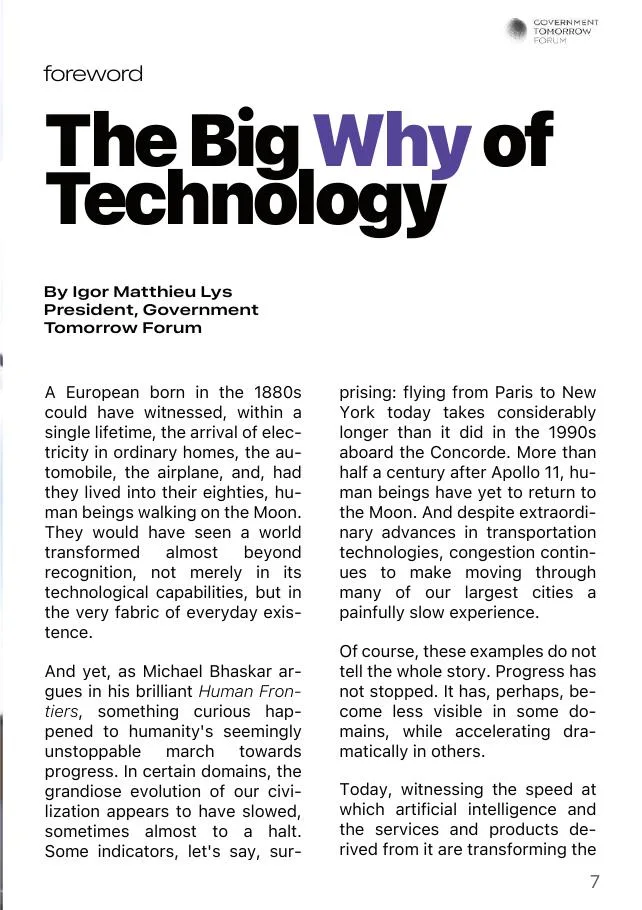
- The Big Why of Technology: foreword by Igor Matthieu Lys.
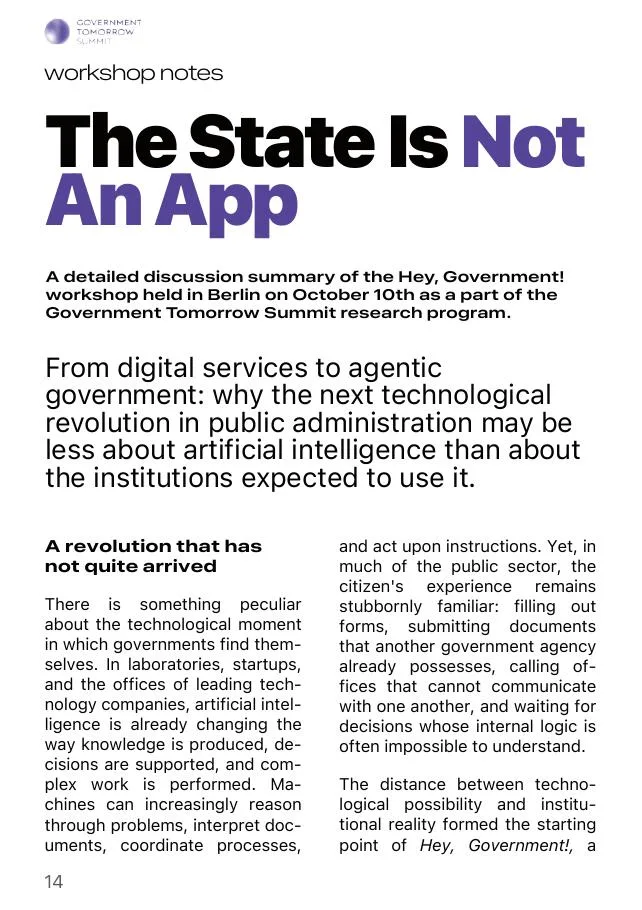
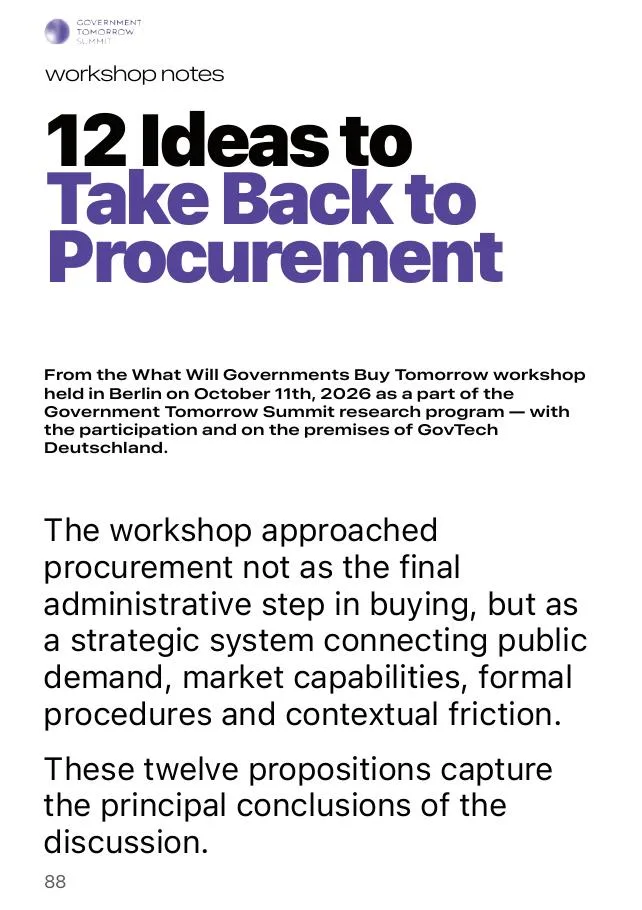
- Hey, Government!: a detailed workshop synthesis and twelve ideas to take back to government.
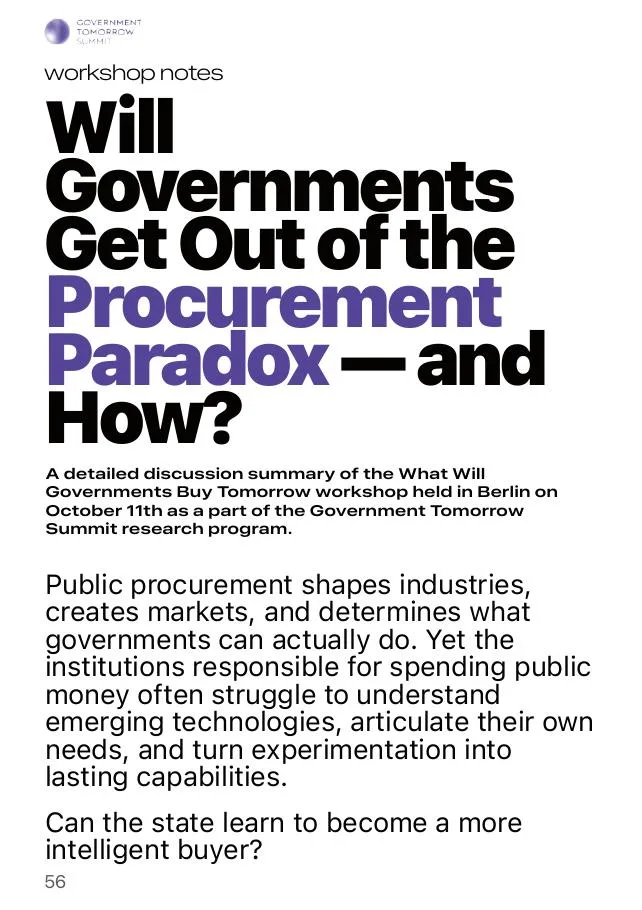
- The procurement paradox: a public-private workshop synthesis and twelve ideas for public procurement.
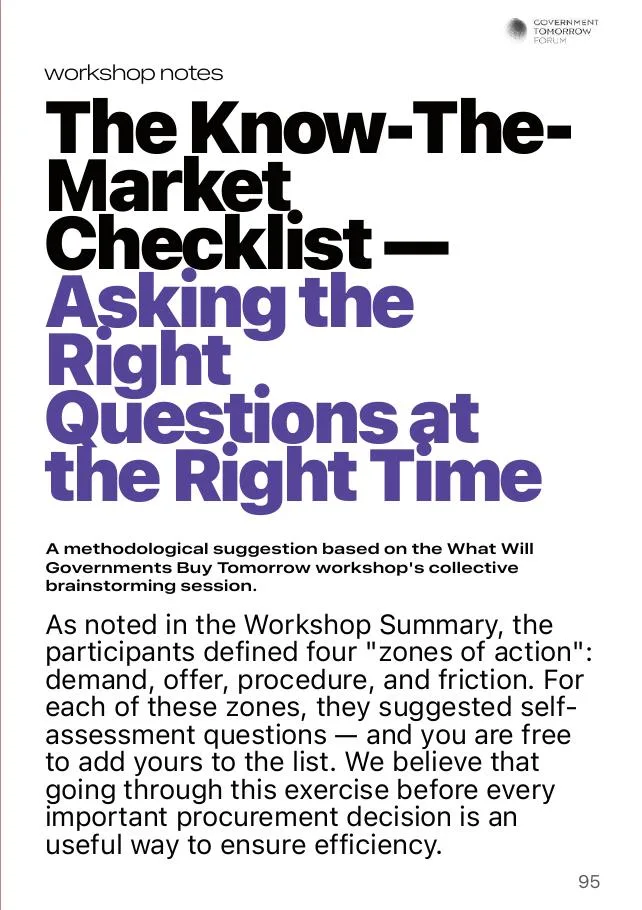
- Know-The-Market Checklist: questions for buyers and suppliers across demand, offer, procedure and friction.
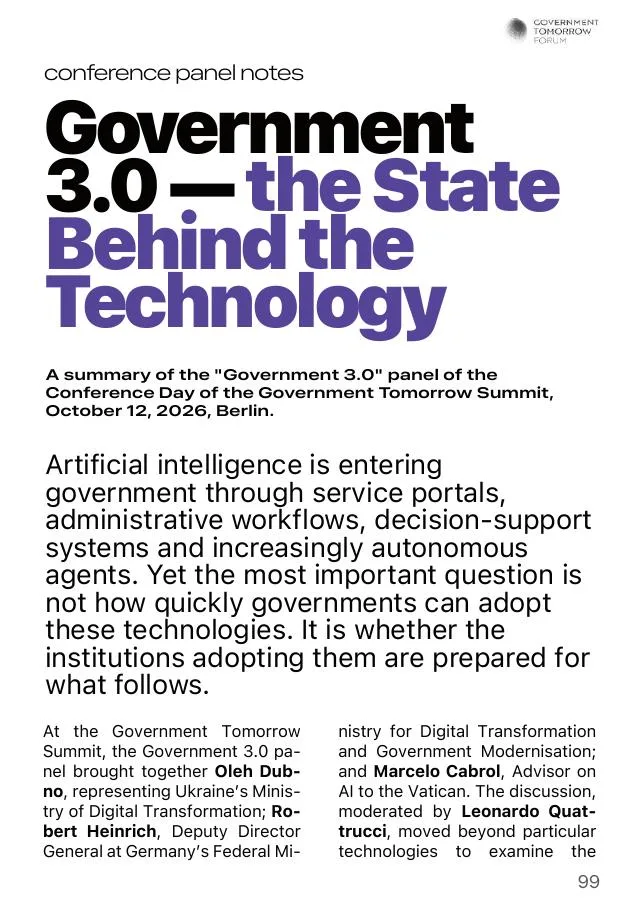
- Government 3.0: panel notes on the institutional State behind the technology.
- Seven pilot blueprints: practical experiments for public-sector transformation.
Ask better questions before buying
The Know-The-Market Checklist connects four zones of action: demand (the public need), offer (what the market can provide), procedure (the legal and administrative purchasing process), and friction (culture, resistance, risks and contextual constraints). It encourages teams to revisit these questions throughout the procurement lifecycle rather than treating requirements as fixed from the start.
Seven proposed pilot projects
These are open implementation blueprints and methods proposed for pilot validation—not evidence of completed deployments.
- Government Demand Signal: communicate future public problems before requirements become rigid tenders.
- Intelligent Client Unit: build the internal multidisciplinary capability to own technology decisions.
- Government Architecture Gate: assess interoperability, portability and the architectural consequences of purchases.
- Friction Lab for Agentic Public Services: remove burdens while protecting safeguards, judgement and human agency.
- National Beta Protocol: test public services transparently at meaningful scale with feedback and escalation.
- Resilient Procurement Stress-Test: examine whether technology and supplier arrangements can sustain essential outcomes under disruption.
- Procurement Memory Project: preserve procurement lessons so that institutions do not repeat avoidable failures.
For public buyers and digital leaders
For public-sector technology leaders, procurement teams, policymakers and suppliers who want investment to strengthen public capability, accountability and citizens’ lives.
Explore Technology & Procurement · Evaluate a public service with GTF Pathways · Government Tomorrow Summit
Summary of the supplied 152-page working manuscript from the October 2026 Berlin Summit. The original cover labels the publication 2027; the uploaded file is marked work in progress. Editorial team: Igor Lys, Paakhi Rajpal, Kartik Kapai, Archie Hood, Jake Kitchiner and Philip Borg.
Pages from the paper
Continue reading
 Insight
Hey, Government! workshop put agentic government’s political problem at the center
At the Government Tomorrow Summit in Berlin, a workshop anchored by a successful tech demonstration moved quickly beyond AI’s technical promise to the harder questions of trust, process reform, public procurement and political will — in preparation of the GTF Summit Paper on tech & procurement.
 Publication
“Hey, Government”: the Agentic State Backbone
Summit paper on tech & procurement for the agentic state.
Berlin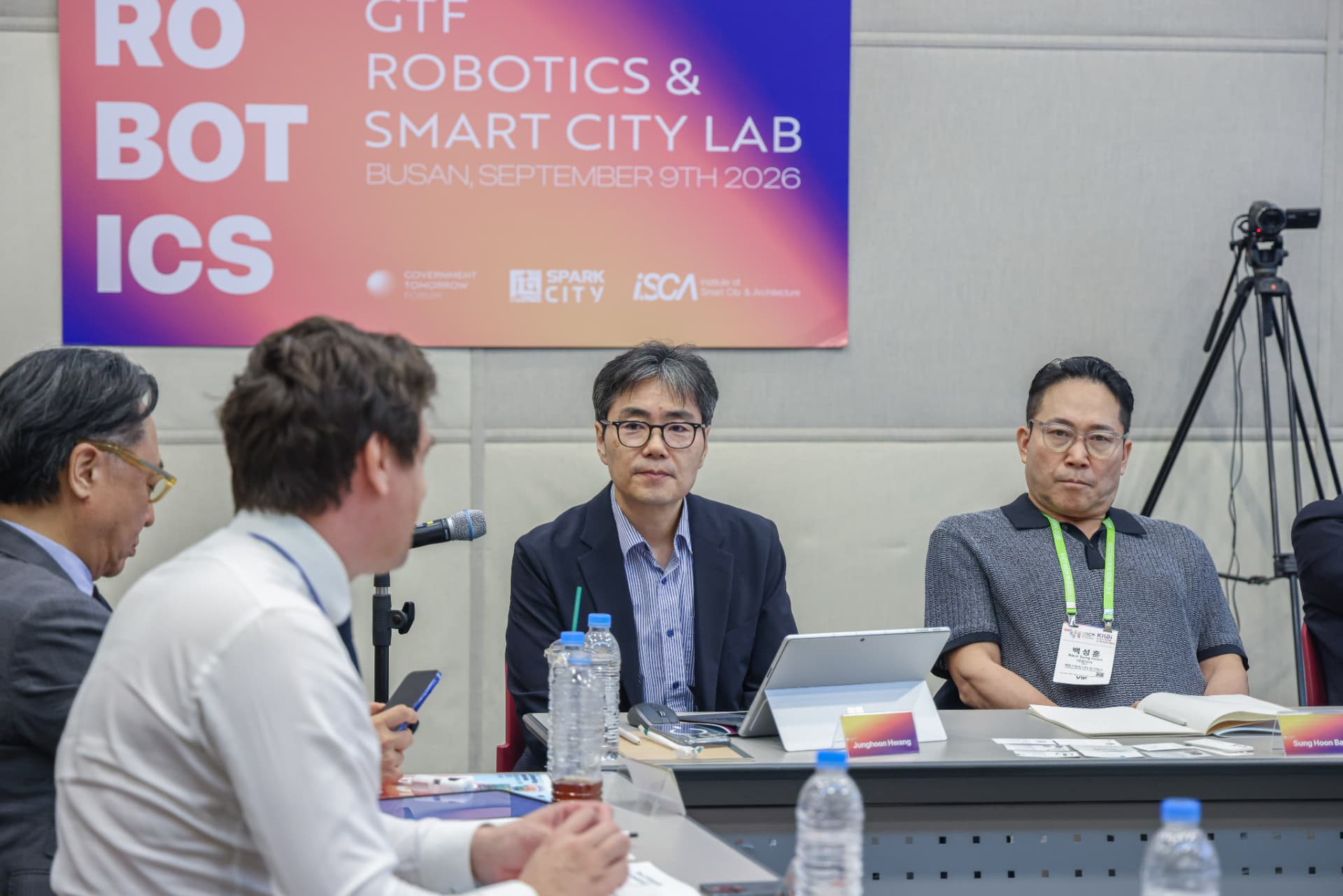 Lab
GTF Robotics Lab South Korea
Governing the Physical AI Transition — GTF’s research platform on Intelligent Cities, Robotics and the Physical AI Transition. From South Korea to the world.
Busan, South Korea