
Robotics — GTF Handbook 2027
The official handbook of the GTF Robotics & Smart City Lab in Busan: why physical AI is a governance question, and the 4R Robotic Readiness Framework for cities and states.
Download the PDF· 3.4 MB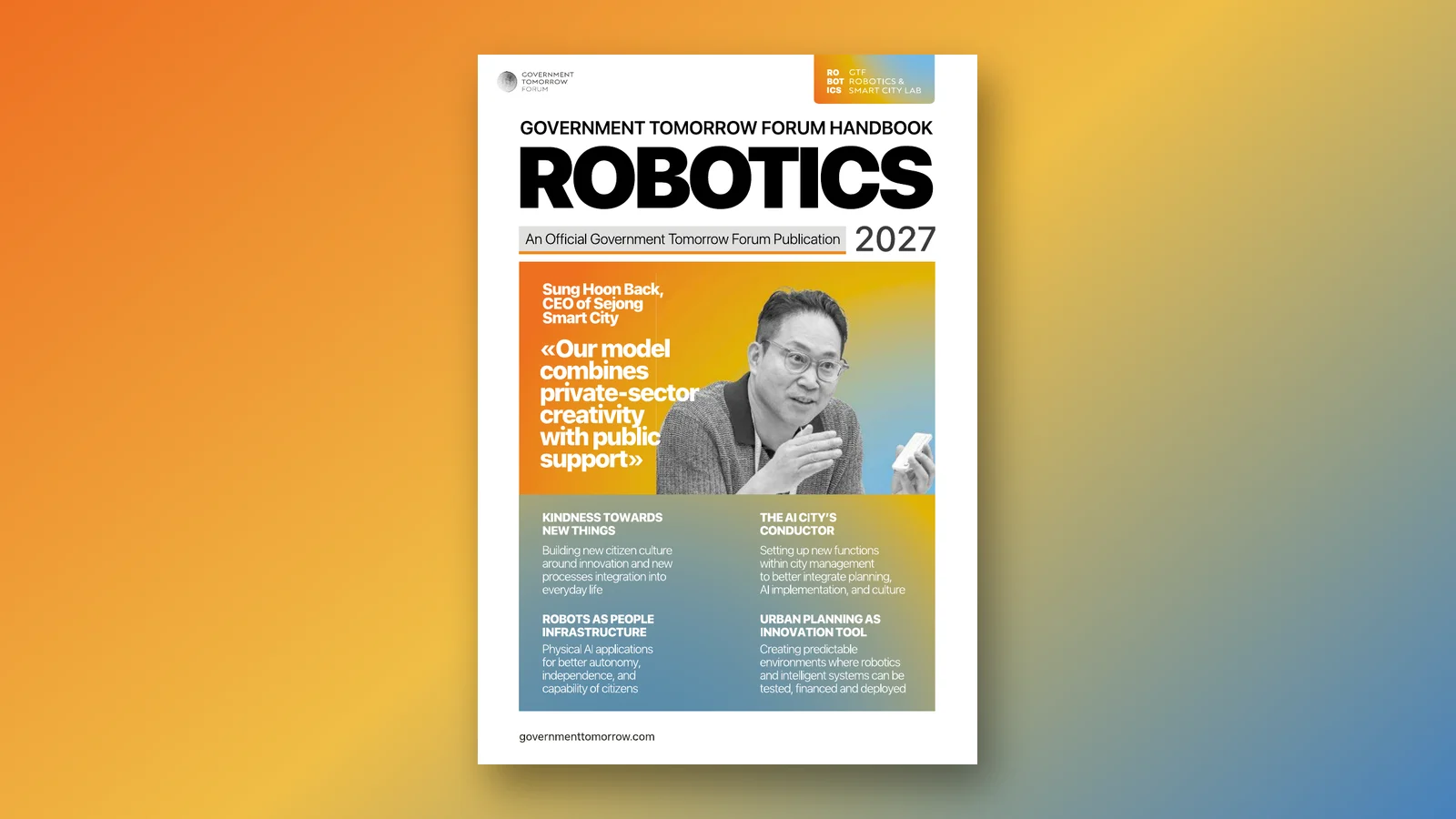
Physical AI is a governance question
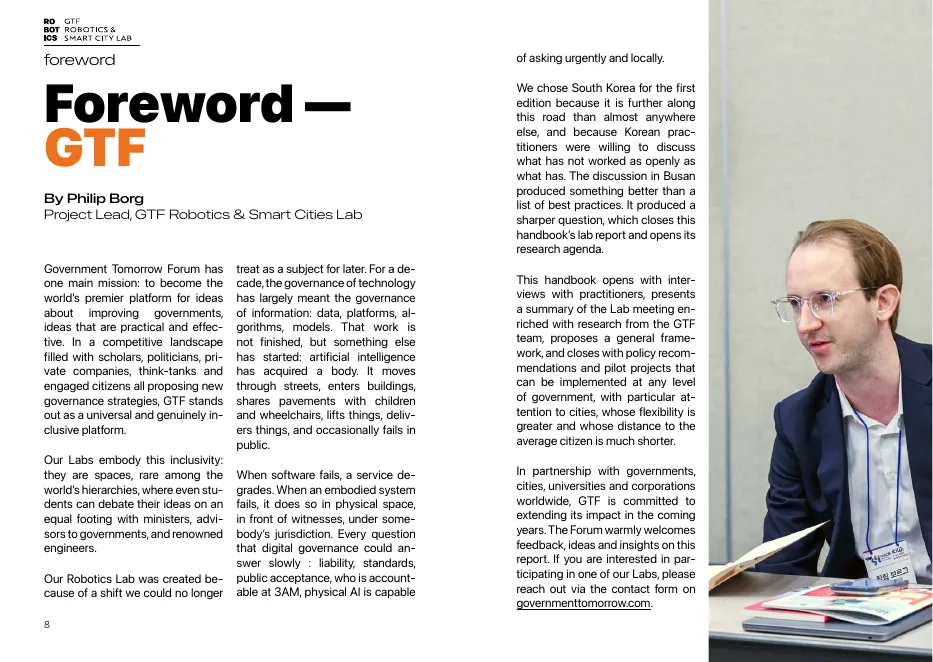
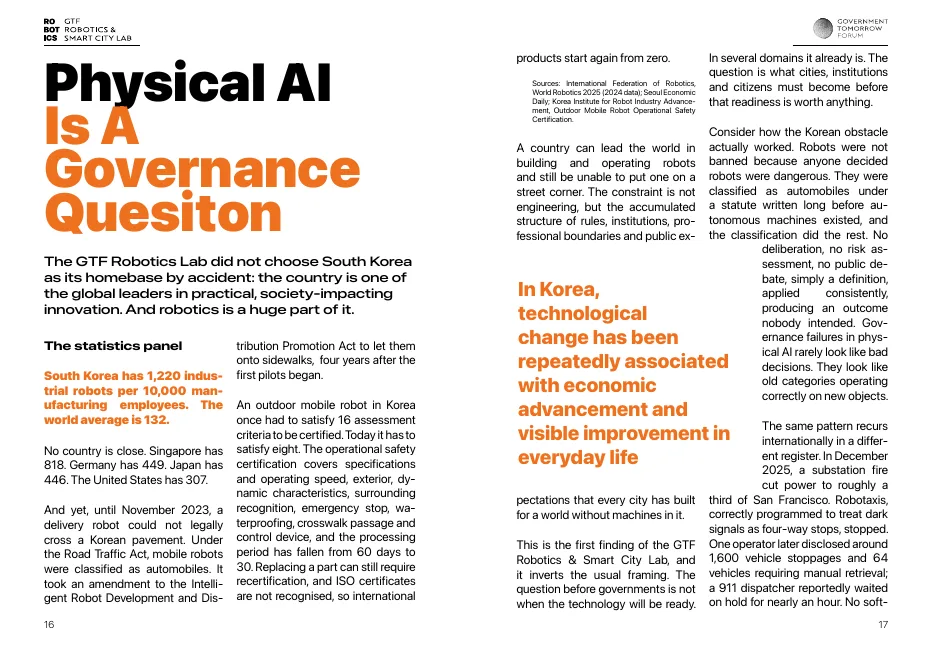
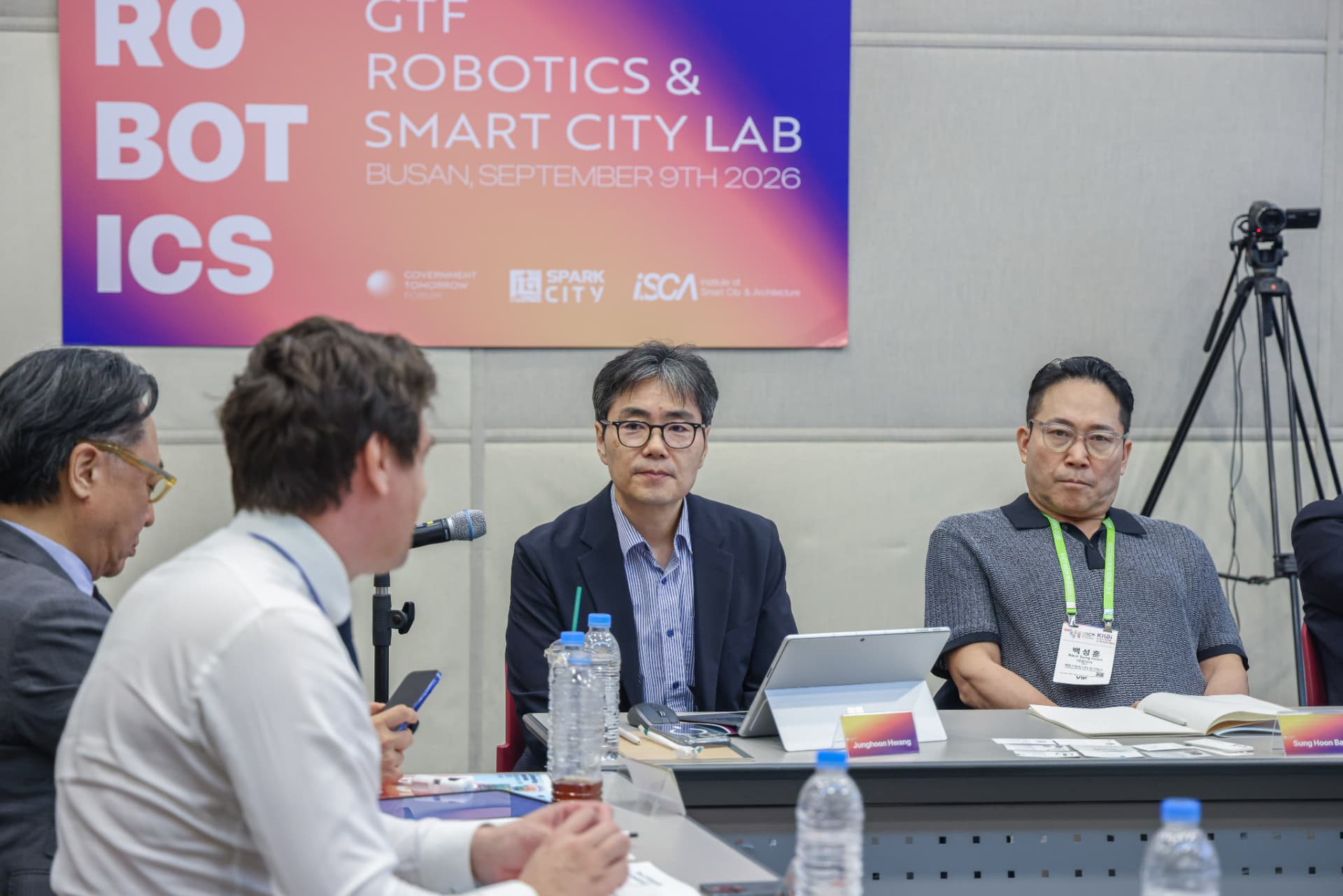
The GTF Robotics Lab chose South Korea as its home base for a reason: the country is one of the global leaders in practical, society-impacting innovation. This handbook gathers the work of the Lab's 2026 meeting in Busan, interviews with Dr. Sung Jin Park (SPARKCITY) and Sung Hoon Back (CEO of Sejong Smart City), and GTF's recommendations for governments at every level.
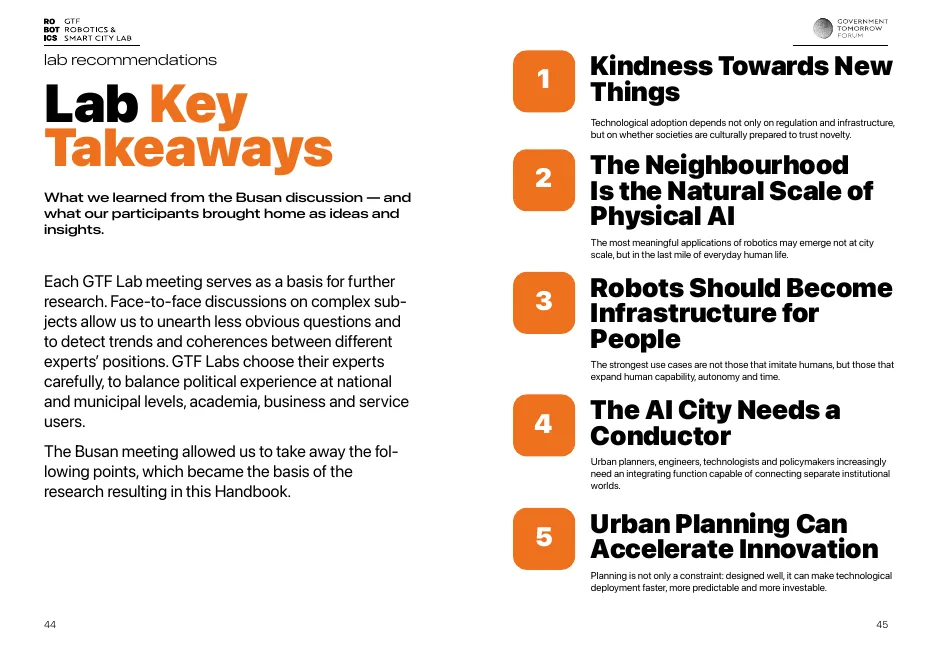
Key takeaways from the Busan Lab
- Kindness towards new things. Technological adoption depends not only on regulation and infrastructure, but on whether societies are culturally prepared to trust novelty.
- The neighbourhood is the natural scale of physical AI. The most meaningful applications of robotics may emerge not at city scale, but in the last mile of everyday human life.
- Robots should become infrastructure for people. The strongest use cases are not those that imitate humans, but those that expand human capability, autonomy and time.
- The AI city needs a conductor. Planners, engineers, technologists and policymakers need an integrating function capable of connecting separate institutional worlds.
- Urban planning can accelerate innovation. Designed well, planning makes technological deployment faster, more predictable and more investable.
The 4R Robotic Readiness Framework
Most governments assume robot-readiness is a procurement problem, solved by buying robots. It is not. A robot that cannot be insured, parked, charged, repaired, reported, explained to a neighbourhood or accounted for after an accident is not a deployed robot. The framework names four readinesses, each owned by different people and each failing independently:
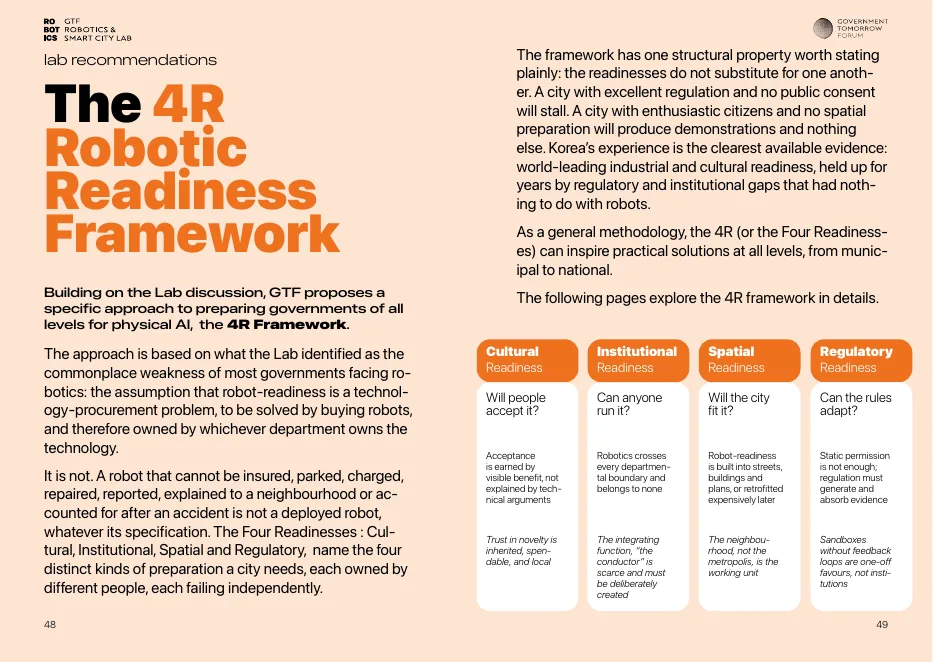
- Cultural readiness — acceptance is earned by visible benefit, not by technical arguments.
- Institutional readiness — robotics crosses every departmental boundary; the "conductor" function must be deliberately created.
- Spatial readiness — robot-readiness is built into streets, buildings and plans, or retrofitted expensively later.
- Regulatory readiness — static permission is not enough; regulation must generate and absorb evidence.
The readinesses do not substitute for one another: excellent regulation without public consent stalls, and enthusiastic citizens without spatial preparation produce only demonstrations.
From research to action
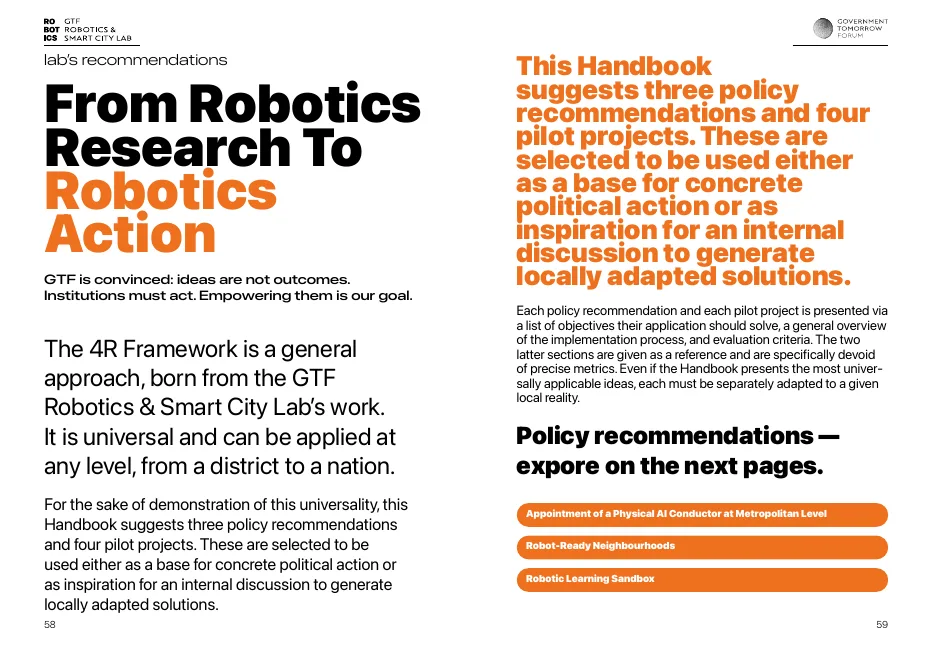
The handbook proposes three policy recommendations — a Physical AI Conductor at metropolitan level, Robot-Ready Neighbourhoods and a Robotic Learning Sandbox — plus four pilot projects, each with objectives, an implementation overview and evaluation criteria.
Explore the GTF Robotics Lab South Korea · Technology & Procurement pillar
Pages from the paper
Full document
Robotics — GTF Handbook 2027
3.4 MB · free to read and share, with credit to the Government Tomorrow Forum.
Download the PDFContinue reading
 PublicationPDF
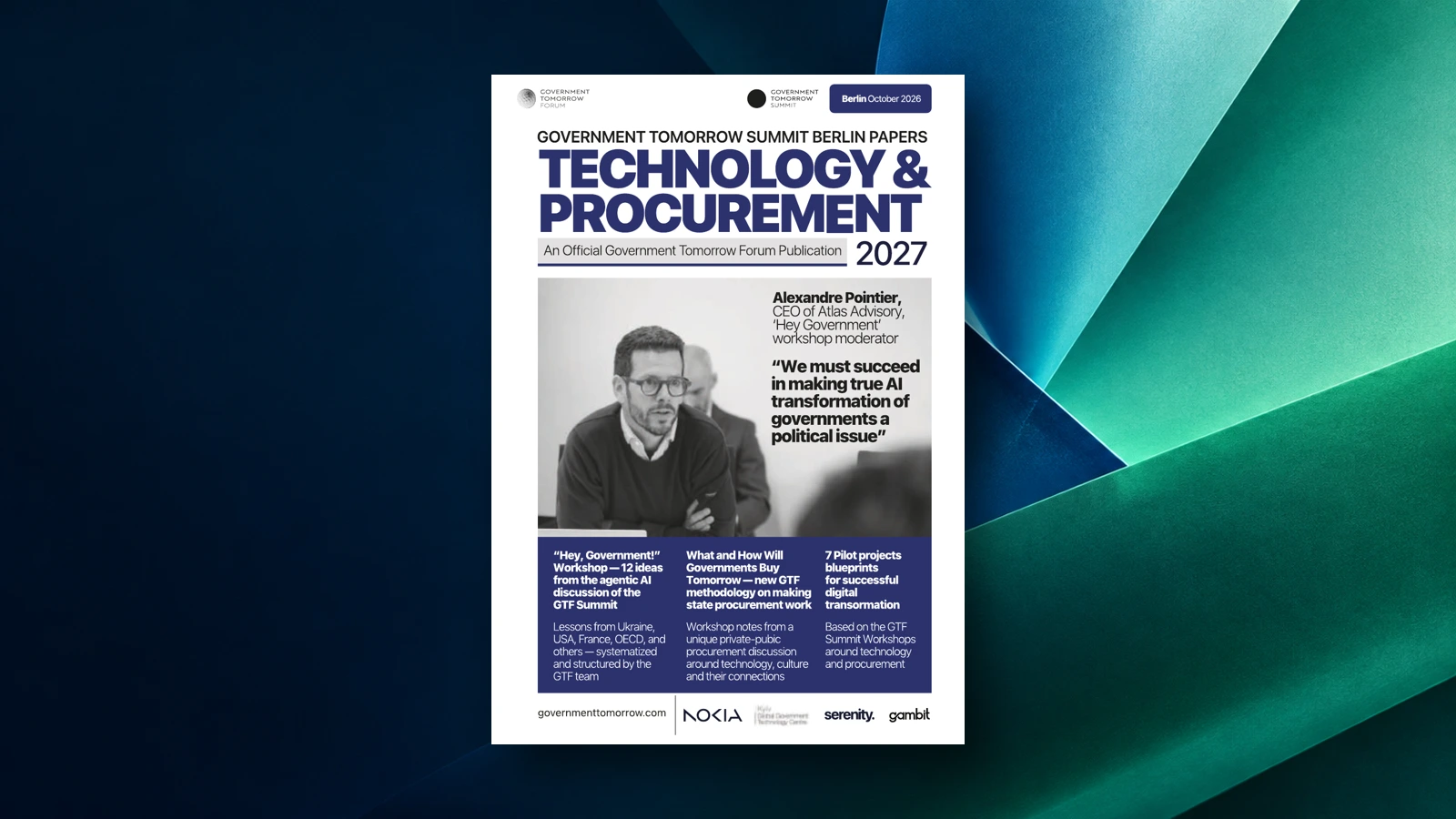
Technology & Procurement — Summit Paper
The State is not an app: agentic AI, intelligent public buying and seven pilot blueprints for meaningful digital transformation.
Berlin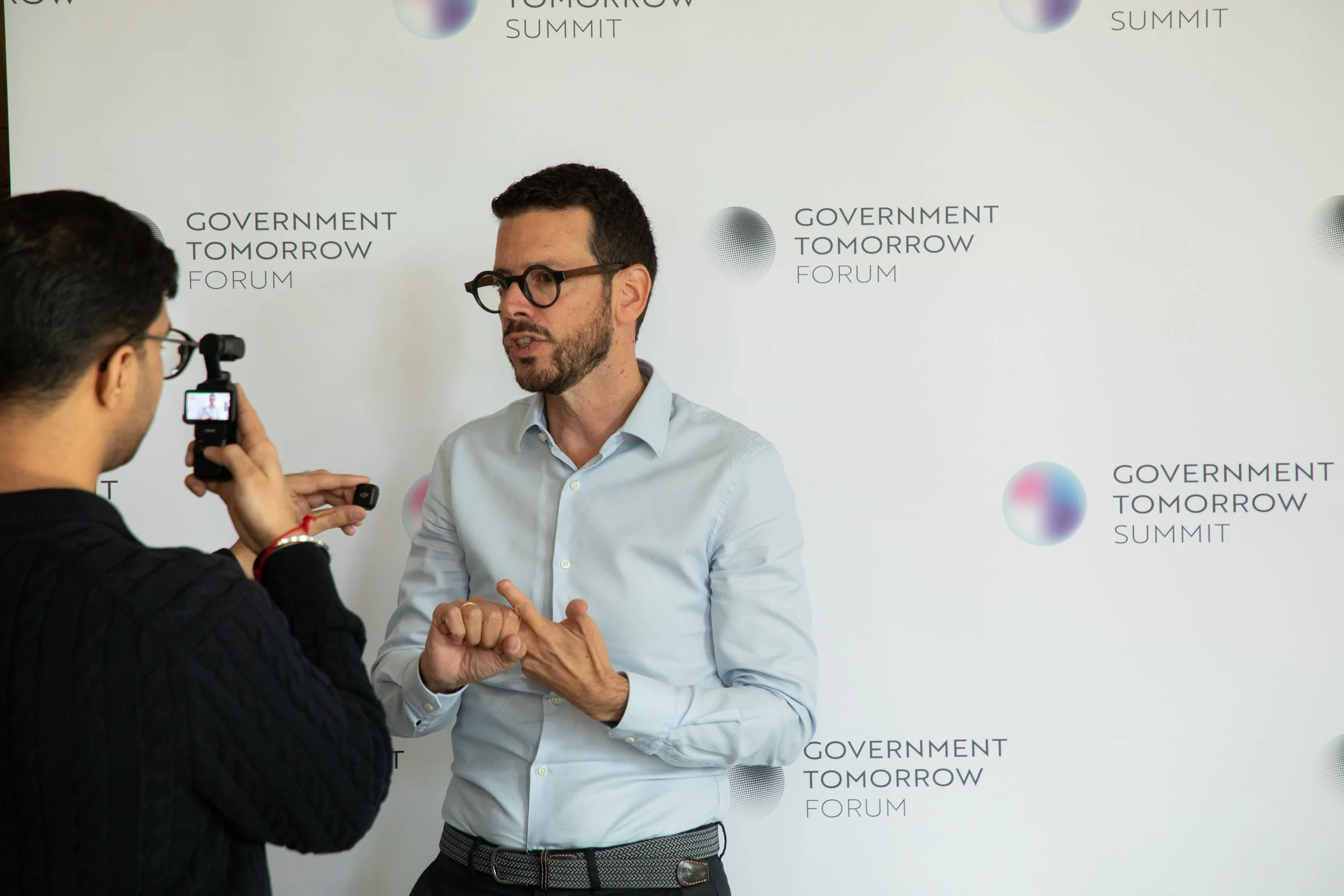 Insight
Hey, Government! workshop put agentic government’s political problem at the center
At the Government Tomorrow Summit in Berlin, a workshop anchored by a successful tech demonstration moved quickly beyond AI’s technical promise to the harder questions of trust, process reform, public procurement and political will — in preparation of the GTF Summit Paper on tech & procurement.
 Lab
GTF Robotics Lab South Korea
Governing the Physical AI Transition — GTF’s research platform on Intelligent Cities, Robotics and the Physical AI Transition. From South Korea to the world.
Busan, South Korea